Businesses have long focused on optimizing keywords and backlinks, but search behavior has changed. Users no longer type queries; they ask and talk to Google, Siri, or ChatGPT for instant answers. Traditional SEO struggles to keep up with this evolution.
That’s where AEO (Answer Engine Optimization) steps in. Unlike SEO, AEO targets AI-driven answer generation and zero-click searches, focusing on how information is interpreted by AI systems rather than just rankings. Algorithms now understand intent, context, and entities, not just keywords.
This blog explores SEO vs AEO and how SEO and AEO work together, why mastering AEO is the next big leap, and how AI, NLP, and conversational search are shaping the future of digital visibility.
What Is SEO? Understanding the Basics
Search Engine Optimization (SEO) is the foundation of online visibility. It improves the frequency at which your website appears in organic search results by optimizing your site for both users and search engines.
SEO uses technical optimization, on-page and off-page strategies, content structure, and link building to enhance visibility, authority, and engagement. High-quality, relevant content remains central to SEO success because it improves rankings and user satisfaction. To maximize visibility, effective SEO content must be built with both user needs and search engine requirements in mind.
Modern SEO also includes semantic search, entity recognition, and topic modeling, helping Google understand the meaning and relationships behind your content.
Meta tags, schema markup, and internal linking improve crawlability, domain authority, and ranking performance. Off-page strategies such as link building and brand mentions further boost credibility and online recognition.
Following Google’s Helpful Content Guidelines ensures your content stays expert-focused, readable, and trustworthy, enhancing user experience (UX) and driving more qualified organic traffic.
How SEO Works: The Role of Semantics and Signals
Search engines index billions of web pages using AI algorithms, neural networks, and deep learning models. Evolving technology, including advancements in AI and machine learning, continues to shape modern SEO practices by enhancing how search engines interpret and rank content.
Traditional SEO depends on these algorithms to rank content and generate organic traffic. Modern systems like Google’s BERT and MUM help interpret search intent and contextual relevance, moving beyond simple keyword matching.
Machine learning allows Google to understand natural language, user intent, and the relationship between entities, improving the precision of search results.
SEO works through three major mechanisms:
- Crawlability and Indexing: Ensures Googlebot can access, crawl, and index your web pages.
- Relevance and Quality: Matches user intent and search queries with valuable, well-optimized content.
- Authority and Trust: Builds credibility through authentic, expert, and experience-backed information.
The future of SEO lies in semantic search and user experience (UX), where engagement signals such as click-through rate (CTR), dwell time, and content interaction guide ranking success.
How BERT Changed SEO
BERT (Bidirectional encoder representations from transformers) enables Google to interpret complete sentences and not just individual keywords. It decodes the associations of words, identifying such subtleties as prepositions, the phrasing of a question, and tone of voice. BERT also helps Google better understand the specific questions users are asking, allowing for more targeted and relevant content delivery.
For example
- Old SEO: The best laptops students could bring up generic pages on laptops.
- BERT-based search optimization: comprehends the purpose of the query “best laptop for students,” which is lightweight, affordable, and study-friendly laptops.
This change implies that content should now be authored in order to appeal to humans, in natural language that directly fulfills the intention of the search, and not only natural language that is machine-friendly.
The H-E-E-A-T Role in Contemporary SEO
With BERT turning search smarter, Google, in turn, came up with H-E-E-A-T (Helpfulness, Experience, Expertise, Authoritativeness, Trustworthiness) as a tool to assess the quality and credibility of the content.
According to Google Search Advocate John Mueller, it is not about the number of keywords and links but rather whether your content will benefit the users in accomplishing their aims.
Let’s break it down
- Helpfulness:
The Google Helpful Content System ranks pages that show actual attempts to educate or help the user. - Experience:
It may be a product review, tutorial, or an explanation of a service, but writing with experience indicates that it is credible and will make users trust the point of view. - Expertise:
It can be either the schema markup that identifies author credentials or data-supported insights to make Google refer to your content as subject matter expertise. - Authoritativeness:
Power is obtained when other people recognize it primarily, by people through links, by citing and mentioning reputed sources. Referrals to your content by trusted websites or publications will enhance the credibility of your domain. Domain authority is a key metric used to measure the overall credibility and ranking potential of a website in SEO
- Trustworthiness:
Long-term rankings are based on trust. It is also evident that contact details, privacy policies, and credible references will make the users (including Google) confident in your content.
Bringing BERT and H-E-E-A-T Together
BERT and H-E-E-A-T can be combined and help regulate the current functioning of SEO:
- BERT is the way in which Google is sure about what is in your content and how it is relevant to the intent of the user.
- H-E-E-A-T makes Google place importance on what you write, as it is accurate, useful, and reliable.
Example
To illustrate the point, when a user searches for the best painting company in Kansas City, the algorithm of Google will scan through the pages of web pages to identify the ones that:
- Apply the target keyword in the natural titles, headings, and meta descriptions.
- Include pertinent and detailed content on the subject.
- Be well-linked by reputable local or industry websites.
- And provide a pleasant user experience (load it quickly, make it mobile-friendly, and make it simple to navigate).
When all these SEO signals are in place, Google penalizes such a page further up the search results page (SERP).
What Is AEO? The Emergence of Answer Engine Optimization
The next step of SEO is the AEO (Answer Engine Optimization) that will serve voice-based and AI-based searchers. AEO and SEO are complementary strategies: while SEO targets traditional search engine results pages, AEO focuses on structuring content for direct answers in AI-powered and voice search experiences. AEO represents the natural evolution of search optimization, building on the foundations established by SEO to meet the demands of AI-driven search.
AEO is aimed at AI-powered answer engines, such as ChatGPT and Microsoft Copilot, which deliver direct, concise answers to user queries. These platforms rely on AI-generated answers and AI answers, making it essential to optimize your content for increased visibility in these new environments.
As AI-generated responses become more common, brands must adapt their strategies to ensure their content is discoverable. AI models and AI tools are now central to how information is understood, extracted, and presented by these systems. The emergence of AI overviews and Google AI features, like Google AI Mode and Google AI Overviews, further changes how users interact with search results. Generative engine optimization is a new approach that complements traditional SEO, helping brands diversify their traffic channels and leverage AI-driven insights.
It’s important to note that AEO is not replacing seo; rather, the idea of AEO replacing seo is a misconception. AEO builds upon SEO principles to improve AI understanding and response accuracy. Relying on just seo is no longer sufficient in the AI era. To stay ahead, brands should adopt AEO strategies to enhance their brand visibility across AI-powered search environments.
Structured data does not ensure rankings, and it enables Google to know more about your content, the first step towards becoming visible in the rich results. – John Mueller
How AEO Works: From Entities to Experiences
AEO unites entities, structured data, and the intent of the user to allow AI to understand context. In the following way:
- Entity-Based SEO: Unites your brand and topics with the Knowledge Graph to increase semantic relevance.
- Structured Data: Allows AI to draw in information and present it in rich results or voice answers.
- Conversational Queries: Prepares your site for voice and conversational search.
- Search Experience Optimization: This aligns with valuable, easy-to-read content and focuses on providing detailed answers to user queries. This shows the intent of the user.
With AEO, your brand is optimized for multimodal search. This ensures AI combines text, voice, and images in a single result. Producing high-quality content is essential for AEO success. Content should be organized so that AI systems can easily understand and accurately interpret user intent.
How AEO Works (additional perspective)
AEO supports search engines in their endeavors to comprehend your data as an answer to a question by using structured data, NLP, and entity recognition. Providing concise answers is crucial, as AI systems and answer engines prioritize clear, brief responses that can be easily extracted and summarized for users, especially in voice search and zero-click results. Delivering such direct and accurate answers not only enhances user satisfaction but also streamlines the search experience.
It increases your presence in:
- Featured Snippets
- People Also Ask (PAA) results
- Knowledge Panels
- Voice Search Responses
- Zero-Click Results
Example
When a user inquires, such as “What is the difference between SEO and AEO?” An optimized page with organized data, concise answers, and a visual contextual hierarchy may be shown as the direct response to the question, no clicking required.
SEO vs AEO: What’s the Real Difference?
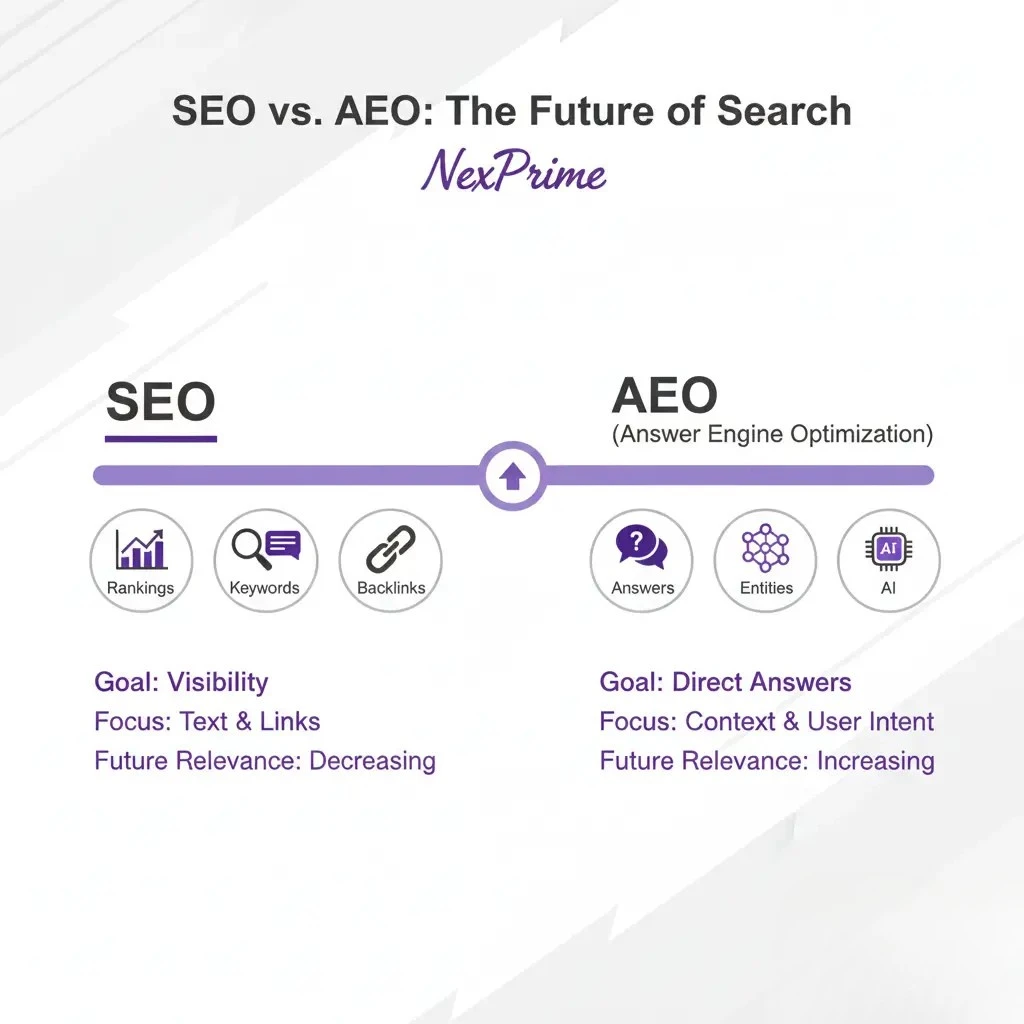
Before diving into the comparison, it’s important to understand the key differences between SEO and AEO. Be sure to check the specific features and explore the unique advantages of each approach to determine which strategy best fits your business needs.
These differences include their purpose, focus, and how they are implemented to help businesses succeed in the evolving search landscape.
Key Differences Between SEO and AEO
| Aspect | SEO (Search Engine Optimization) | AEO (Answer Engine Optimization) |
|---|---|---|
| Goal | Rank higher on search engine pages, especially in Google search results and other search engines like Bing | Provide instant, accurate answers and improve visibility in Google search results and AI-driven platforms |
| Focus | Keywords, backlinks, and ranking | Entities, context, and intent |
| Primary Medium | Text-based search results | Voice and AI-driven responses |
| Optimization Method | On-page, off-page, and technical SEO | Structured data, NLP, and schema markup |
| User Intent | Informational, transactional, navigational | Conversational and contextual |
| Output Format | Webpage listing | Featured snippet, Knowledge Graph, or AI answer |
| Future Relevance | Essential foundation | Next evolution in AI-driven search |
Unlike traditional SEO, AEO is specifically customized for AI-driven, zero-click search environments, where users expect direct answers from virtual assistants, chatbots, and other emerging technologies. For a comprehensive strategy, it’s also important to consider optimizing for other search engines beyond Google, as platforms like Bing are gaining relevance.
Both SEO and AEO ultimately aim to improve visibility in Google search results, but they do so through different methods and outputs, reflecting the changing ways users interact with search technologies.
SEO + AEO: The Smart Hybrid Strategy for Businesses
Don’t pick one, do both!
Why?
- SEO builds your foundation. It helps your pages show up when people search.
- AEO takes that visibility further by helping your content appear in voice results, featured snippets, and instant answers.
Optimizing content for both SEO and AEO strategies maximizes your organic visibility, ensuring your site ranks well in search results and is easily found by answer engines. When you use both, you cover clicks and answers. Your content is seen by searchers who browse, as well as those who want quick information.
Example (SEO + AEO in action)
Suppose that a user queries or commands an AI assistant:
“Who gives me cheap SEO services?”
SEO in action
The site of NexPrime Agency ranks top on Google due to optimizing its site with:
- Local keywords such as SEO Services in Islamabad.
- Quick speed of page loading, mobile friendliness.
- Blogs on SEO improvement are quality backlinks.
- And an impressive Google Business Profile.
This makes it visible; the site is on the first page in search results.
AEO in action
At the same time, the site uses:
- Structured information (marking up reviews, services, locations).
- Natural language conversation which is similar to the way that people interrogate.
- Distinct headings and frequently asked questions that directly respond to questions, such as the cost of SEO Services: how much does it cost to get global SEO services? Or duration of website ranking: how long would it take to rank a website?
These strategies help keep content visible in AI-powered answer engines and generative search results.
This provides meaning and context, which means that Google or AI assistants can extract and reveal accurate responses, which may even be presented as a featured snippet or as a voice response.
Result
SEO (visibility + authority) and AEO (precision + relevance) result in a Search Experience Optimization (SXO) where users can find the brand with ease, as well as trust and interact with it immediately. Those businesses adopting the two will rule the future of organic and AI search.
How to Optimize for SEO & AEO (Hybrid Roadmap)
- Keyword Structure: Layer primary, secondary, and LSI terms with proper keyword research.
- On-Page & Schema: Add FAQ/How-To markup & clear headings; strong on-page structure with optimized headers and alt text.
- Content Format: PAS method, short paragraphs, lists.
- Content Creation: Focus on creating content that answers user questions and conversational search queries to improve rankings.
- Optimizing Content: Structure content to be concise, authoritative, and easily understood by answer engines and AI.
- Internal Linking: Connect pillars to clusters.
- EEAT/HEEAT: Show expertise with data & references.
- Entity Optimization: Highlight brands/services with schema.
- Search Intent: Match content to user questions.
- Direct Answers: 40–50 word snippets.
- Technical Optimization: Fast load, mobile-friendly.
- Monitor & UX: Track snippets, add visuals.
Hybrid Tip: “SEO for traffic + AEO for answers = Full visibility.” The most effective digital marketing strategies come from SEO and AEO working together, ensuring both traditional and AI-driven search demands are addressed.
Defining Some Core Points
- On Page and Schema
- Optimize your on-page structure and use FAQ and How-to schema so search engines can read your content better.
- Keep headings short and direct.
- Add clear answers under each subheading so they can appear in snippets or voice results.
- Include schema tags for key details such as services, reviews, and contact information.
- Content Format
- Follow the P.A.S. method in your introduction to capture attention.
- Keep paragraphs short and conversational. Aim to provide concise answers to user questions for better clarity and to help AI summarize your content.
- Use bullet points and lists to make ideas easy to scan.
- Avoid difficult words and filler sentences.
- Technical and Performance Optimization
- Make sure your site loads fast and works smoothly on mobile devices.
- Use clean URLs, SSL, and proper indexing.
- Submit an updated sitemap to keep content discoverable.
- Strong technical health supports both SEO and AEO visibility.
Measuring Success in AEO and SEO
Measuring the effectiveness of your answer engine optimization (AEO) and search engine optimization (SEO) strategies is essential for understanding how well your website is performing in today’s search landscape. Traditional SEO metrics such as keyword rankings, organic traffic, and conversion rates remain the foundation for evaluating your search engine optimization efforts. These indicators help you track how well your site is ranking in search results and how much organic traffic you’re attracting.
However, answer engine optimization AEO introduces a new layer of measurement. Success in AEO is often reflected in the number of featured snippets your content earns, how frequently your answers appear in voice search results, and how often AI-generated answers cite your website. Tools like Google Analytics, along with specialized SEO monitoring platforms, can help you track both traditional SEO metrics and these newer AEO-specific indicators.
By combining valuable insights from both sets of metrics, you gain a comprehensive view of your online visibility. This holistic approach allows you to see not only how much traffic you’re getting, but also how often your content is being selected as a direct answer by search engines and AI platforms. Ultimately, tracking both AEO and SEO performance empowers you to refine your digital marketing strategy, optimize your content, and stay ahead in the evolving world of search engine optimization.
Why AEO Is the Future of Search
With conversational AI and generative AI redefining human searching, users today require quick, accurate, and satisfactory answers, not a list of links.
AI-Driven Search
Google’s SGE uses generative AI, vector search, and contextual embeddings to improve natural language understanding. Google’s AI Principles say this allows people “to find high-quality, relevant information”.
Voice & Conversational Search
Almost half of all searches worldwide are voice searches. AEO makes sure your content is optimized to track natural speech, predictive search, and AI platforms such as Gemini and ChatGPT. The market share of major AI chatbots like ChatGPT, Microsoft Copilot, and Google Gemini highlights their dominance and reflects the evolving competitive landscape in AI-powered search.
Featured Snippets and Zero-Click Results
The trend toward zero-click searches means many users never leave the search results. This shift reduces the importance of traditional blue links in search results, as users increasingly get immediate answers on the SERP. That’s why being visible as the answer becomes critical. AEO strategies aim to secure those direct answer placements
Personalized Search
Today’s search utilizes intent matching, personalization, and context. AEO maximizes responses using user behavior and search intent, as Google’s updated personalized results indicate.
Content Experience (CX) and SXO
AEO combines SEO and UX through Search Experience Optimization (SXO). By combining AEO and SXO, your content is structured to satisfy users’ expectations for fast, relevant, and authoritative answers.
FAQs related to SEO vs AEO
What is the difference between AEO and SEO?
AEO is all about giving AI and voice search straight answers, while SEO is all about how pages rank in search engines. AEO uses organized data, entities, and short answers to make websites more visible, while SEO uses keywords and links to do the same.
Which is better: SEO or AEO?
SEO and AEO work together because neither is better. To rank on Google, you need SEO, and AEO helps your content show up in AI replies and voice results. When you use both, you get the best total visibility.
How to optimize a website for AEO?
It is best to use organized facts, clear headings, and short, direct answers. Cover entities that are connected to your topic, add FAQ schema, and write content that sounds like a conversation. Pay attention to what the user wants so AI can easily figure out your answer.
Conclusion
This shift from SEO to AEO mirrors the way search is moving away from keywords and rankings towards meaning and relevance. With generative AI, conversational AI, and Google’s SGE transforming discovery, the brands adopting entity-based SEO and AEO will conquer search engines and AI answer systems.
Ready to be the answer people are searching for?
Contact NexPrime Agency today to start your SEO + AEO success story.
Let’s grow your visibility and become the trusted source your audience is looking for.